
A Kyushu University team used a solid to convert visible light into ultraviolet. It was a great parting gift for their lab leader.
Gabriela Silva
Nobuo Kimizuka had 11 days left at his laboratory at Kyushu University when his research team handed him a manuscript.
For more than a decade, Kimizuka and his colleagues had wrestled with a persistent problem: How to make a process work as well in a rigid solid as in a free-flowing liquid.
The manuscript covered just that.
The study, published in Nature Communications in June 2026, describes a solid – built around a molecule called dihydroindeno[2,1-a]indene, or DHI – that turns visible light into ultraviolet light. Light is made up of tiny packets of energy called photons. Ultraviolet photons carry more energy than those in visible light. The team wanted the solid to take in low-energy photons and shoot out more energetic ones. That’s called photon upconversion. And they did it with light no brighter than ordinary sunlight.
For Yoichi Sasaki, one of the authors, the research grew from work Kimizuka began in 2012. But progress sped up less than a year before the latter retired. Sasaki, an associate professor of applied chemistry at Kyushu, helped lead the study. In a press release, he called the manuscript a heartfelt retirement gift.
Two weak photons equal a strong one
A light’s color tells you how much energy its photons carry. Ranked by energy, of those colors we can see, red has the least and violet the most. Above violet comes ultraviolet (ultra is Latin for “beyond”); below red comes infrared (infra, “below”). We can see neither.
A TV remote’s invisible beam is infrared, and so has too little energy for our eyes to see. A blacklight and the light of a tanning bed are mostly ultraviolet. The eye’s cornea and lens absorb that light before it reaches the retina. Ultraviolet’s extra energy can drive chemical reactions ordinary light cannot. That is why it tans and burns skin.
Losing energy is easy, Sasaki says. A white T-shirt glowing under a blacklight does that. Brighteners in the fabric take in ultraviolet and give back weaker blue light.
“The lower side to higher side is much more difficult,” he says. Brighter red light won’t do it, because that only means more red photons, each as weak as before. But photon upconversion pools the energy of two weaker photons.
Twice blessed
Two kinds of molecule working in turn is what this needs. The first, the sensitizer, is a catcher. It absorbs visible light. The second, the emitter, eventually sends out ultraviolet light. The emitter can’t do any catching because it takes in only ultraviolet. So the sensitizer catches the visible light and hands the energy over. But it does more than just catch light.
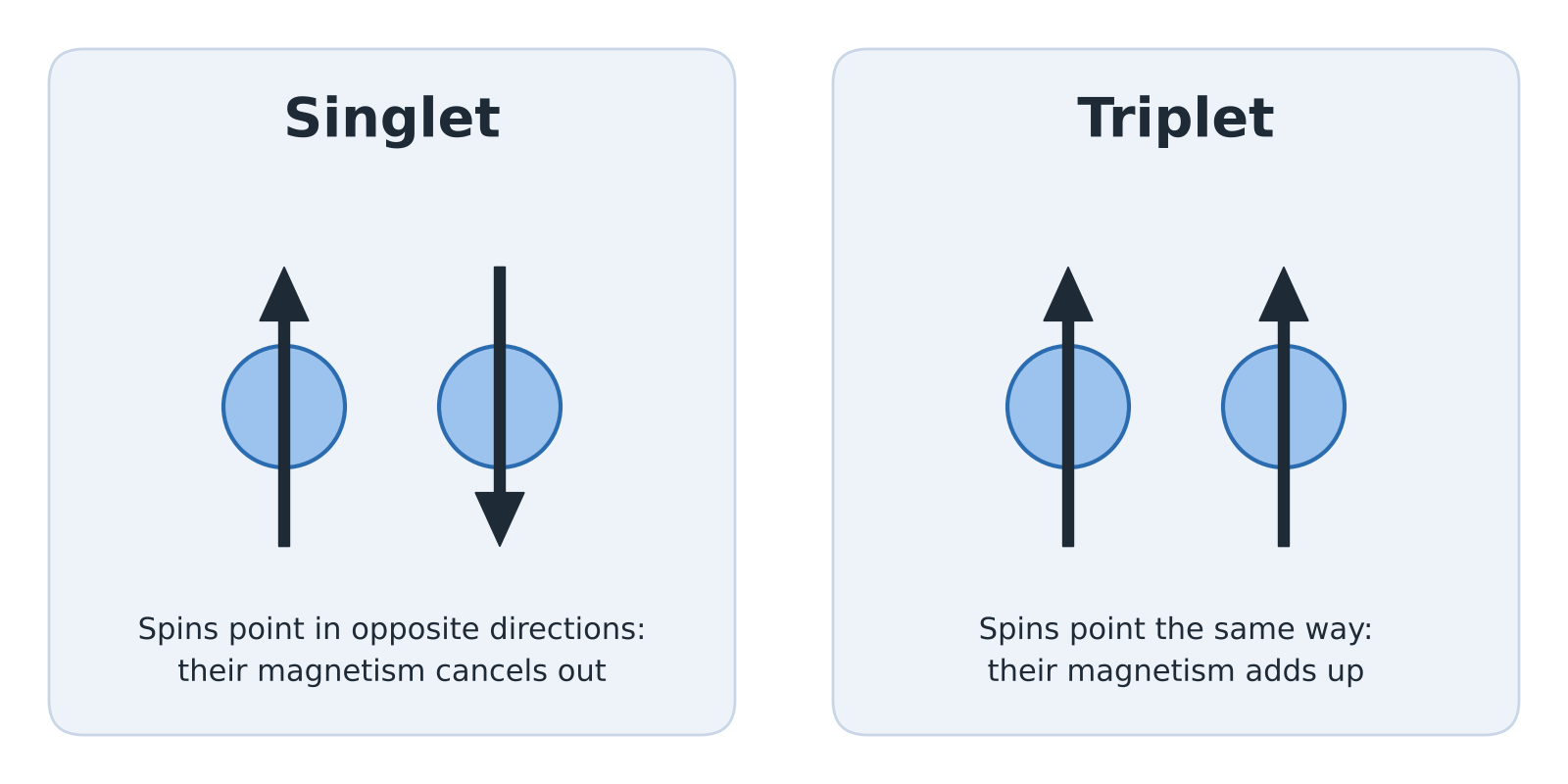
The reason lies in a property of electrons that physicists call “spin,” a relic of the 1920s, when they pictured the electron as a spinning ball. Nothing actually spins. But the property of “spin” makes each electron act like a tiny magnet, pointing up or down. Usually electrons pair off, one pointing each way. When the sensitizer absorbs light, one electron flips, so that two point the same way – a state chemists call a triplet.
The sensitizer used here is good at making a flip. At its heart sits an atom of iridium, a heavy metal. The trick is iridium’s heavy core. An electron moving near it at high speed feels a strong magnetic pull created by its own motion. This is strong enough to make its tiny magnet tumble over.
The sensitizer hands this triplet energy to the emitter – which has no iridium to help it flip back. The emitter cannot release light until one electron flips back. That takes a while. So the energy waits, like a set mousetrap. Kimizuka’s lab set out to study such lingering energy in 2012.
While waiting, one energized emitter can bump into another, passing on its energy. The other now has more energy – enough to kick out a single ultraviolet photon. It is called triplet–triplet annihilation when two tiny bits of light energy pool into one.
This is important because sunlight is mostly visible light and carries too little ultraviolet – the kind of light that most materials for splitting water into hydrogen and oxygen need.
A hard place
Sasaki says that liquid is an unwieldy medium to use for practical ultraviolet production. Solvents can leak, dry up or be toxic. A solid locks molecules in. In a liquid, energized emitters wander about until meeting their twins. In a solid, molecules are already close together, and energy can easily hop from one to the next.
But when packed too close, molecules interfere with each other and lose energy “as heat instead of light,” as Gang Han of UMass Chan Medical School puts it. The light is muffled, the way a ringing bell goes dull under a pressed hand. Chemists call this quenching, as in putting out a fire.
So molecules have to be at the Goldilocks distance – close enough for energy to hop quickly between molecules, but not so close that it gets quenched. This was the main obstacle to making upconversion work in solids.
Maintaining that distance
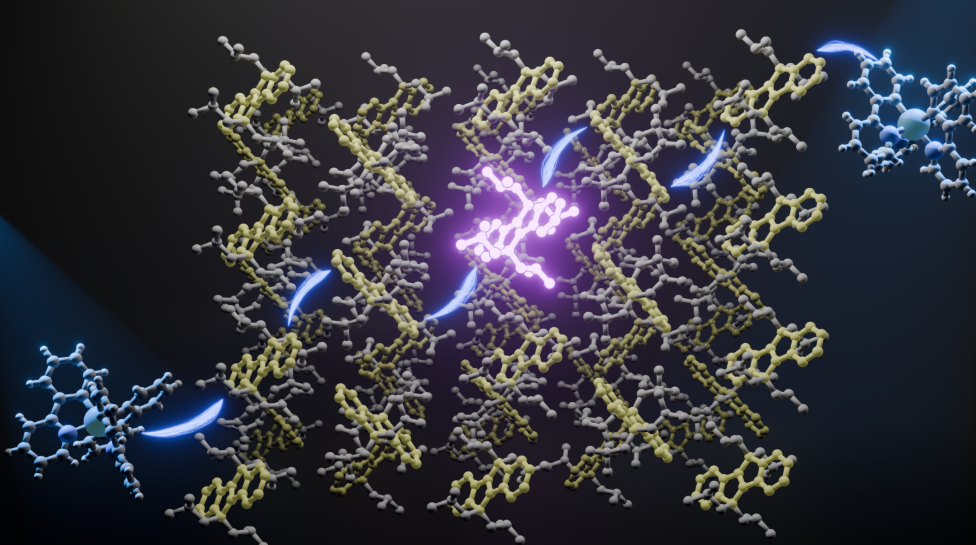
Sasaki’s group started work on a flat core of the molecule, called DHI, made of rings of carbon atoms. When flat cores stack face to face, like plates in a cupboard, they sit close enough to quench each other.
Molecules used for upconversion have traditionally been flat all over because their carbon atoms bond in a flat pattern, Sasaki says. So his group modified the molecule, squeezing in carbon atoms that bond in three dimensions instead. From these they hung short side chains pointing up and down like the legs of a stool and acting as spacers. Neighbors are close enough to pass on energy but not to quench their light.
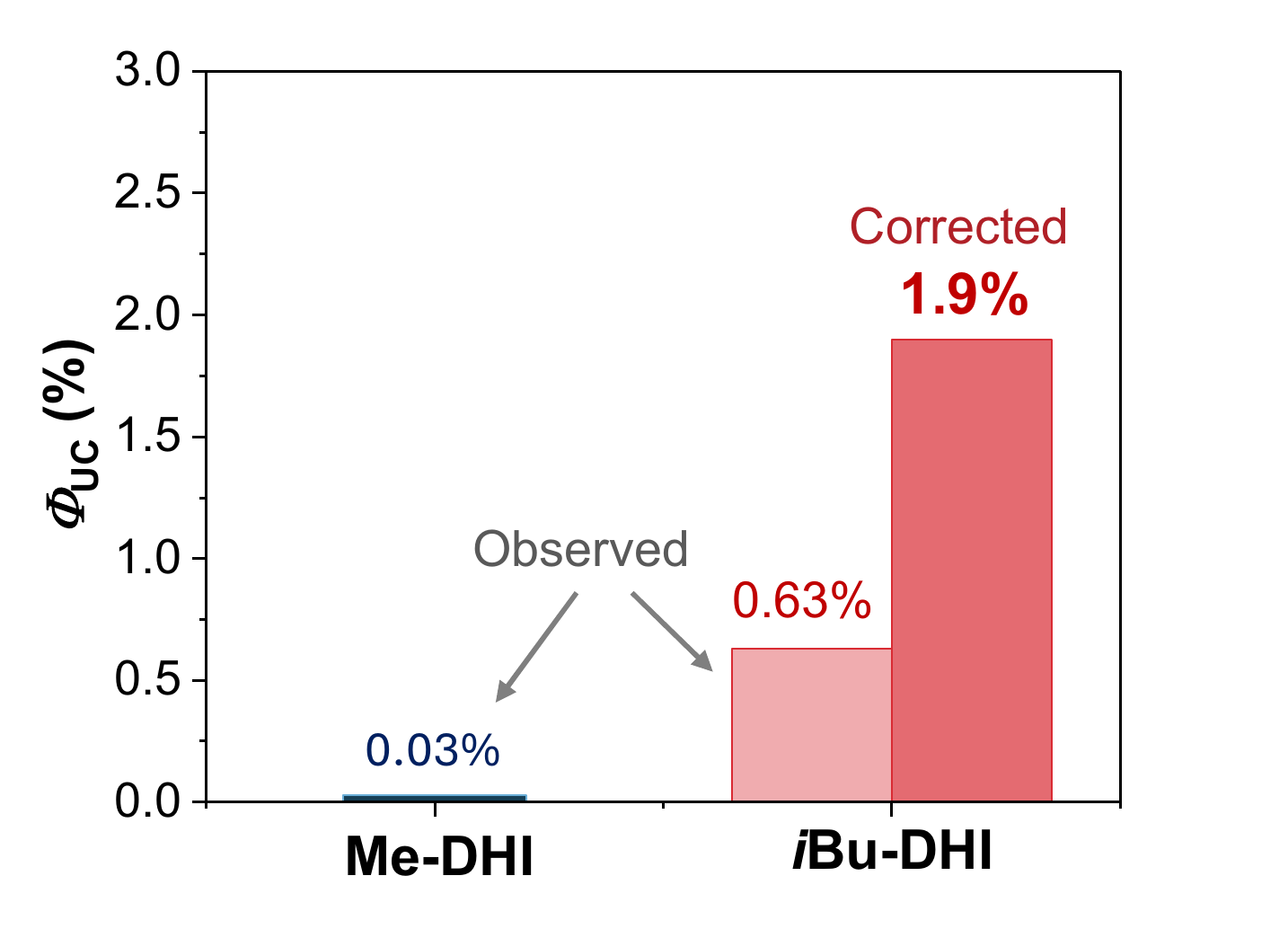
The team got the right spacer on its first try. Still, the members tried shorter and longer versions to find out why that worked, comparing side chains of three sizes. Energy drained eight times faster than their best model when the spacers were smallest. The largest kept neighbors so far apart that, the team calculated, energy passage was more than 10,000 times slower. A plain DHI molecule in a solid with no side chains produced no detectable ultraviolet light.
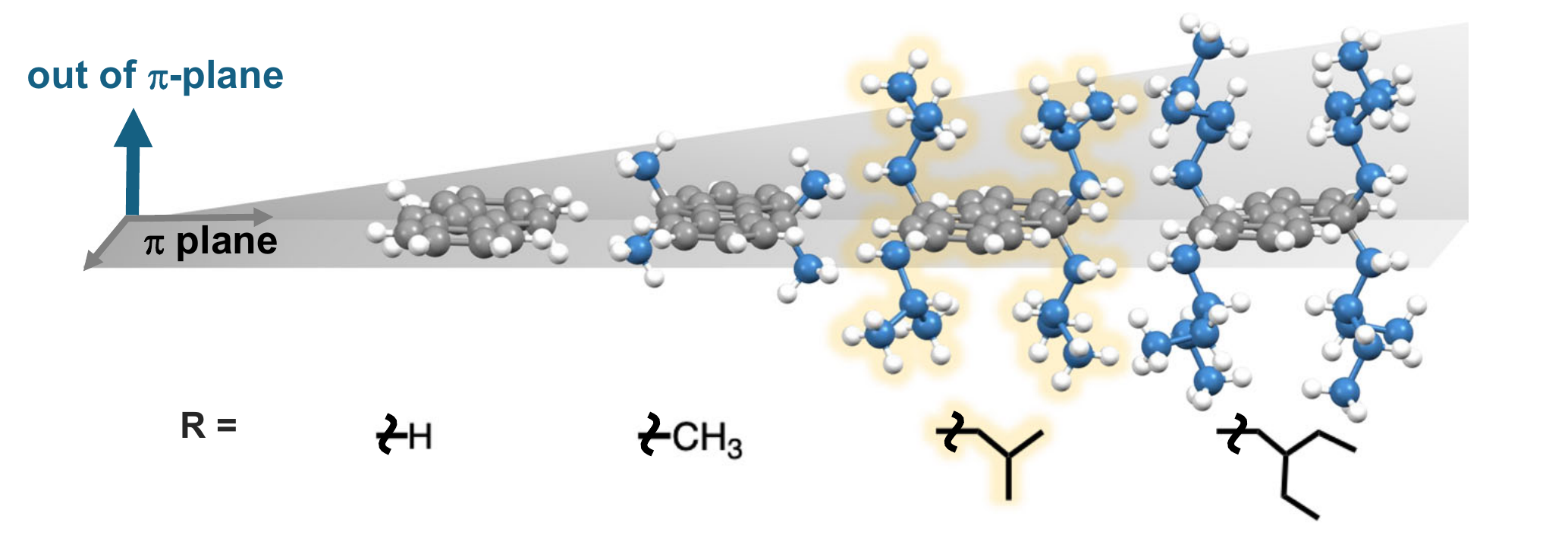
Getting that spacing right was crucial, Sasaki says. The distance between molecules has to be “not too much separated, but not too close to each other.”
Fortunately, the middle one, a short branched chain called isobutyl (the paper’s iBu-DHI), was in the Goldilocks zone.
Chance and the prepared mind
Sasaki has reason for relief.
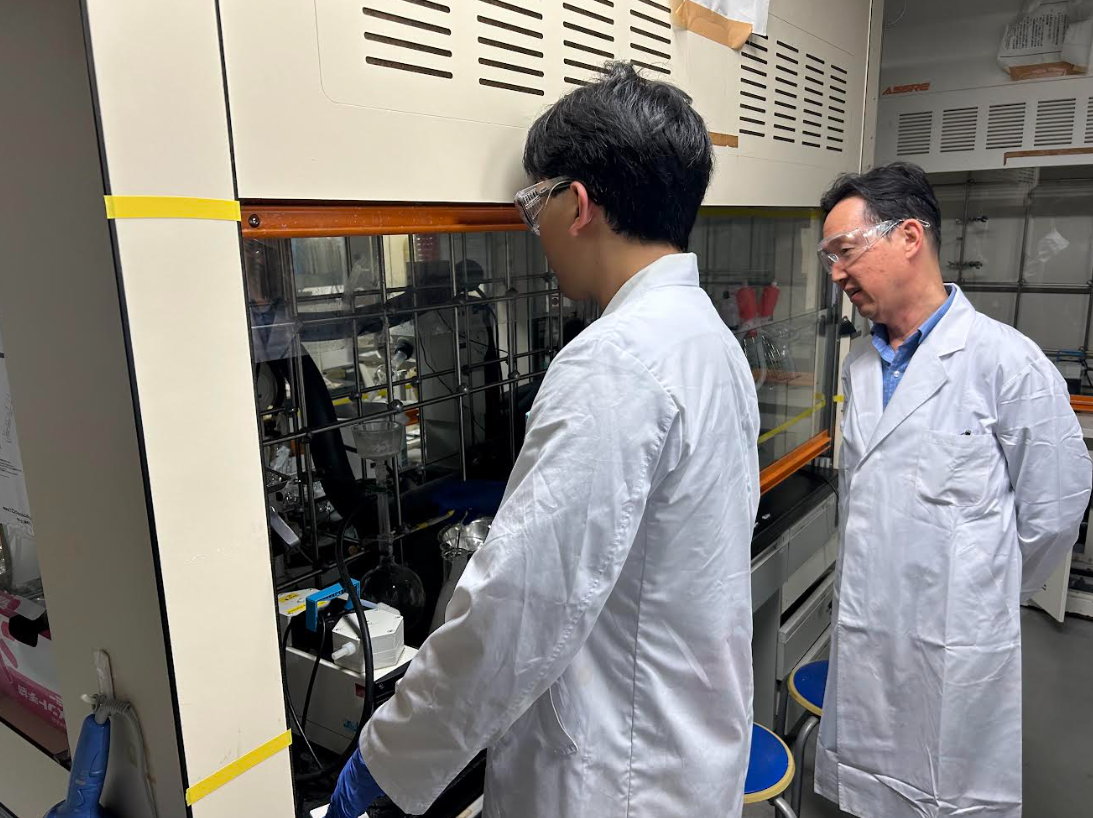
“Lucky it worked,” he says of the design. He also recalls a compound that looked unpromising enough to be thrown away. He tried it as a solid anyway, and it performed far better than expected. The lesson: don’t dismiss a sample that seems to have failed. The big breakthrough came in May 2024.
What the numbers mean
The paper’s two headline numbers measure different things.
The first, 1.9%, measures how much of the light the solid absorbs is converted to ultraviolet. That works out to about two ultraviolet photons, Sasaki says, for every 100 visible ones absorbed.
The second, 1.2 milliwatts per square centimeter, is the threshold where there are enough energized emitters to start meeting, pass on energy, and release sufficient ultraviolet light. That threshold lies a little below the brightness of sunlight – in the blue colors that the sensitizer catches.
Sasaki says some earlier systems were efficient but needed strong light, while others worked with weak light but were not efficient. This one does both.
Han, a professor who studies upconversion, thinks the design matters at least as much as the numbers.
“What I find most interesting is that the authors have addressed a very basic challenge in photon upconversion: how to make it work well in a solid material,” he says.
Han says suitable spacing between molecules might work in many other upconversion materials. He calls the 1.9% figure “super encouraging.” What excites him more is how little light is required.
“You do not necessarily need a powerful laser to drive the upconversion,” he says.
Weighing in
Christoph Weder, a professor of polymer chemistry and materials at the University of Fribourg in Switzerland, points out that “this is not the highest efficiency ever reported.” But he adds that it is one of the strongest demonstrations to date of a solid doing this at sunlight-level intensity. He was impressed that light similar to standard sunlight is enough for the system to work, in principle without relying on mirrors or lenses to concentrate the light.
That does not mean 1.9% of all the sunlight hitting the material turns into ultraviolet. The sensitizer catches only a narrow band of colors, Weder says, pointing out that light outside that band – “which unfortunately includes most of the sun’s spectrum” – goes unused. The efficiency counts only the photons actually caught.
Yoichi Murakami, a professor at the Institute of Science Tokyo whose group works on the same problem, feels the 1.9% figure “should be regarded as low.” His own group reported 4.3% for a solid in 2023, measured under different conditions. He also stresses that the threshold was measured with a laser rather than sunlight, and that the material used breaks down under strong light. The paper itself reports it breaks down in air, but says sealing the material away from air helps.
Putting it to work
Ultraviolet is used in some air purifiers to kill germs and to harden gel nail polish. The team’s list of possible uses for the new solid includes sunlight-powered chemistry to split water, indoor air cleaning, and 3D printers that rely on hardening liquid resin with light. They have applied for a patent.
Han sees upconversion as “a kind of ‘energy booster'” for such chemistry. The next test, he says, is to use the material in a real chemical reaction to show that the ultraviolet light generated improves the reaction under sunlight or similarly weak light.
Weder worries about the material’s longevity.
Ultraviolet light and the energized molecules that make it are great at starting chemical reactions, including within the material itself, slowly wearing it out. After all, things left in sunlight can fade and crack.
The sensitizer also works in a narrow band of colors. It may help to find ways to widen it, without losing efficiency or durability.
These are normal, practical problems that have to be solved before a good laboratory experiment converts into an efficient working technology.
Finding the real limit
Naturally Sasaki’s group is trying to make a more efficient solid.
While in theory the ceiling is high, in practice, using a solid can result in trade-offs, he writes in a follow-up email. Energy has to be passed down a chain of molecules (scientists call the traveling packet an exciton) but tiny flaws in the crystal can trap it on the way. Also, electron spin does not allow for every meeting of two energized emitters to result in an ultraviolet photon. The team wants to design crystals to reach the practical limits of efficiency. The new material manages these problems, shining brightly, holding on to its energy for a long time and passing it along quickly, even with imperfections in the crystal.
According to Sasaki, today’s solar cells make poor use of near-infrared, the invisible light just below red. His field would like to put even that to use, turning it into visible light, in a solid and under weak light.
They do know that controlling the space around a molecule’s flat core lets you decide how molecules will behave before they are locked into a solid.
Han says, “I think this idea may be more important than the specific efficiency number reported in the paper.”
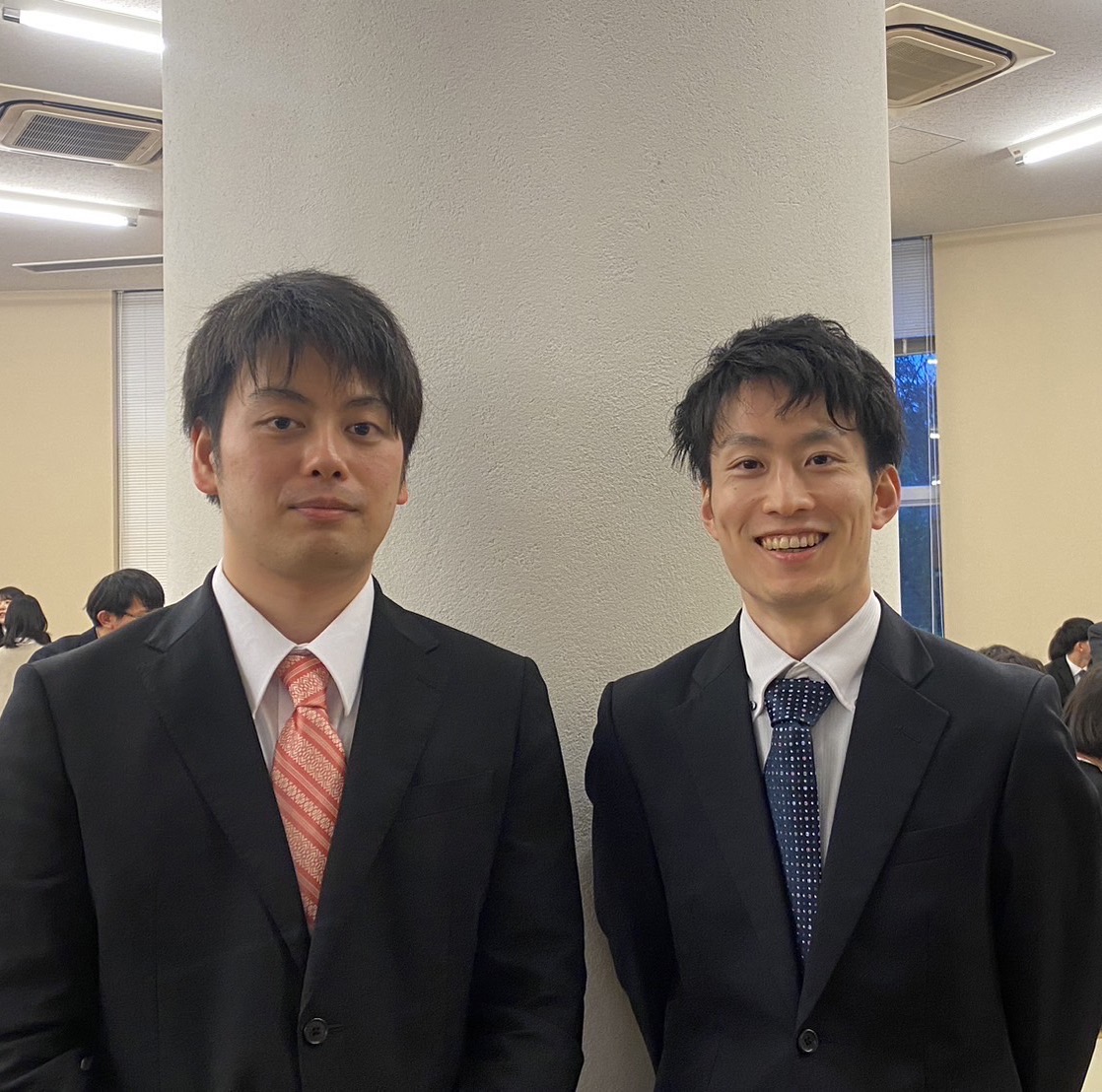
A scientific handoff
Kimizuka began work on photon upconversion more than a decade ago. As his retirement neared, graduate students Naoyuki Harada, Hayato Shoyama and Nutnicha Boonmong, along with Sasaki and Kiichi Mizukami, dealt with the matter with more urgency.
“We thought we should finish it… before his retirement,” Sasaki says. “So we asked many students to get together.”
And that is how the manuscript reached Kimizuka 11 days before he left the laboratory.
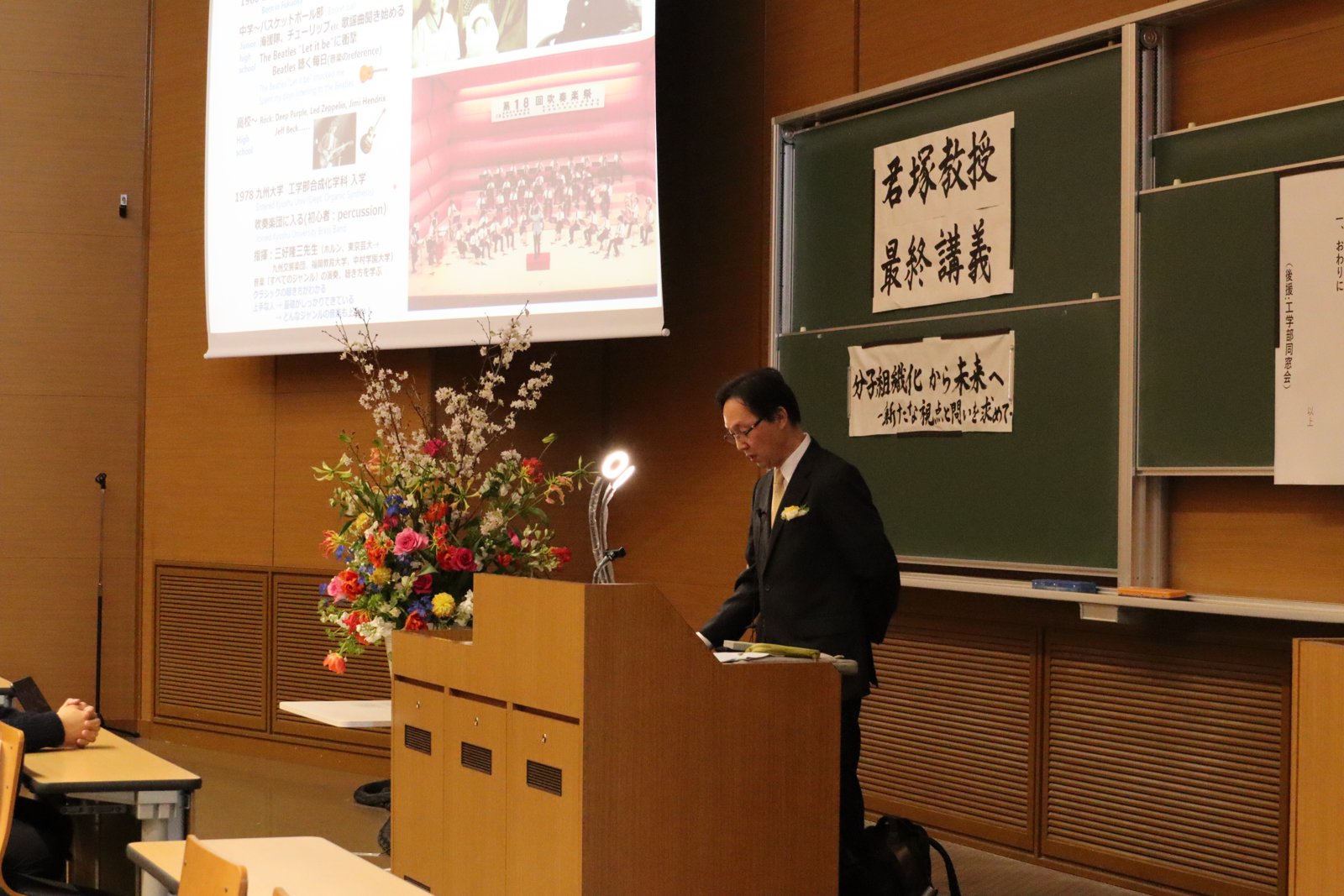
Photographs from his final lecture, on March 14, 2025, show him at the lectern before a packed hall.
The new solid is not a working solar device. It needs to work with more colors and get more efficient. And yes, it is not clear how well it will do outdoors. But it settles a lingering question: molecules in a solid can be close enough to share energy and still far enough apart to keep it.
Still, Kimizuka has not gone far from his old team. Now a professor emeritus at the university, he still connects with his old group. The kind of send-off he got is hard to get away from.

Gabriela Silva is a Brazil-based writer who enjoys making scientific research accessible. She has a background in food science and technology and is pursuing a master’s degree in plant production.
Read the original article.
Top image: Visual concept by Truly Curious, generated by Google Gemini.
Electron-spin diagram: Truly Curious, drawn with Claude (Anthropic).