
Physics says stars should not be able to make black holes beyond a certain mass. Fabio Antonini thinks he knows how that still happens
Mina Rehman
Read this story in a shorter version, written for younger readers
When Fabio Antonini was ten, his parents gave him a small telescope. It was a tiny thing, but it did something huge: it opened up the sky. A book about the planets and constellations did the rest, and the obsession stuck.
Today Antonini is a senior lecturer at Cardiff University’s Gravity Exploration Institute, and he has an explanation for one of the odder facts about the cosmos: black holes, the usual fate of large stars, come only in certain sizes.
The path there started with a choice. Studying physics at Sapienza Università di Roma in 2002, he had to pick a specialty.
“The courses in astronomy sounded much more cool than the physics ones. Like Extragalactic Astrophysics! Planetary Dynamics,” he said, laughing.

“My imagination was running more with those titles than with Quantum Physics or Structure of Matter.” He wrote a thesis on the evolution of star clusters around a black hole – and quickly ran into how much bigger the subject was than any one head could hold.
“The universe is so vast and immense that it is very difficult even to imagine,” he says. “But in the end, we can understand some of the processes that occur in the universe – and maybe even simulate the entire universe – on a computer.”
To see why some black holes are so hard to explain, it helps to know how stars die. And dying, for a star, is really one contest staged over and over: gravity pulling inward, and something – heat, a quirk of quantum mechanics, or in the end nothing at all – pushing back. How a star finishes depends entirely on what it has left to push with.
A biography of the stars
For most of its life a star is a standoff. Gravity wants to crush it inward; the outward pressure produced by fusion in the core holds the line. In stars like the Sun, much of that support comes from hot gas. In the most massive stars, radiation pressure from photons becomes especially important. Hold that idea. When those photons start disappearing, the catastrophe begins.
As a star ages and burns through its hydrogen, the core fills with helium, the outer layers billow out into a red giant, and the core contracts and heats until it can fuse that helium into heavier elements. A helium nucleus is compact – two protons and two neutrons. Fuse three helium nuclei together and you get carbon; add another helium nucleus to carbon and you can make oxygen.
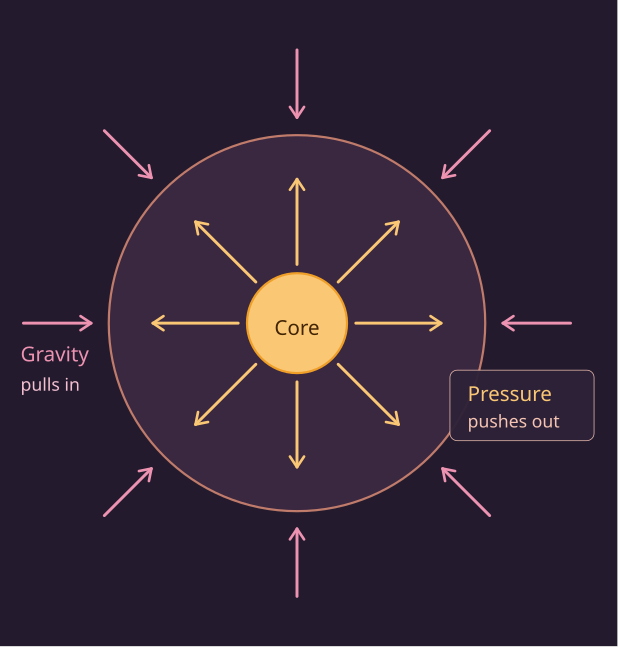
For a star like the Sun, that is the end of the line. Its gravity isn’t strong enough to fuse anything heavier, and once fusion sputters out, that outward pressure goes with it. Gravity closes in – and meets a wall it didn’t expect. The star’s electrons, crowded as close as quantum rules allow, push back through a force called electron degeneracy pressure. Quantum mechanics forbids any two electrons from occupying the same state at once, so once every available slot is filled, they simply refuse to be packed closer. This effect results in the star becoming a white dwarf, cooling quietly over billions of years. No white dwarf can ever weigh more than about 1.4 times the Sun, a ceiling called the Chandrasekhar limit.
But heavier stars, those with a core heavy enough to blow past that limit, keep contracting. This keeps generating heavier fuel, all the way up to iron. That is where fusion stops paying for itself. Building anything heavier than iron costs more energy than it yields. When the fuel runs out, the core collapses. The outer layers may explode as a supernova, while the crushed core becomes either a neutron star or, if it is massive enough, a black hole.
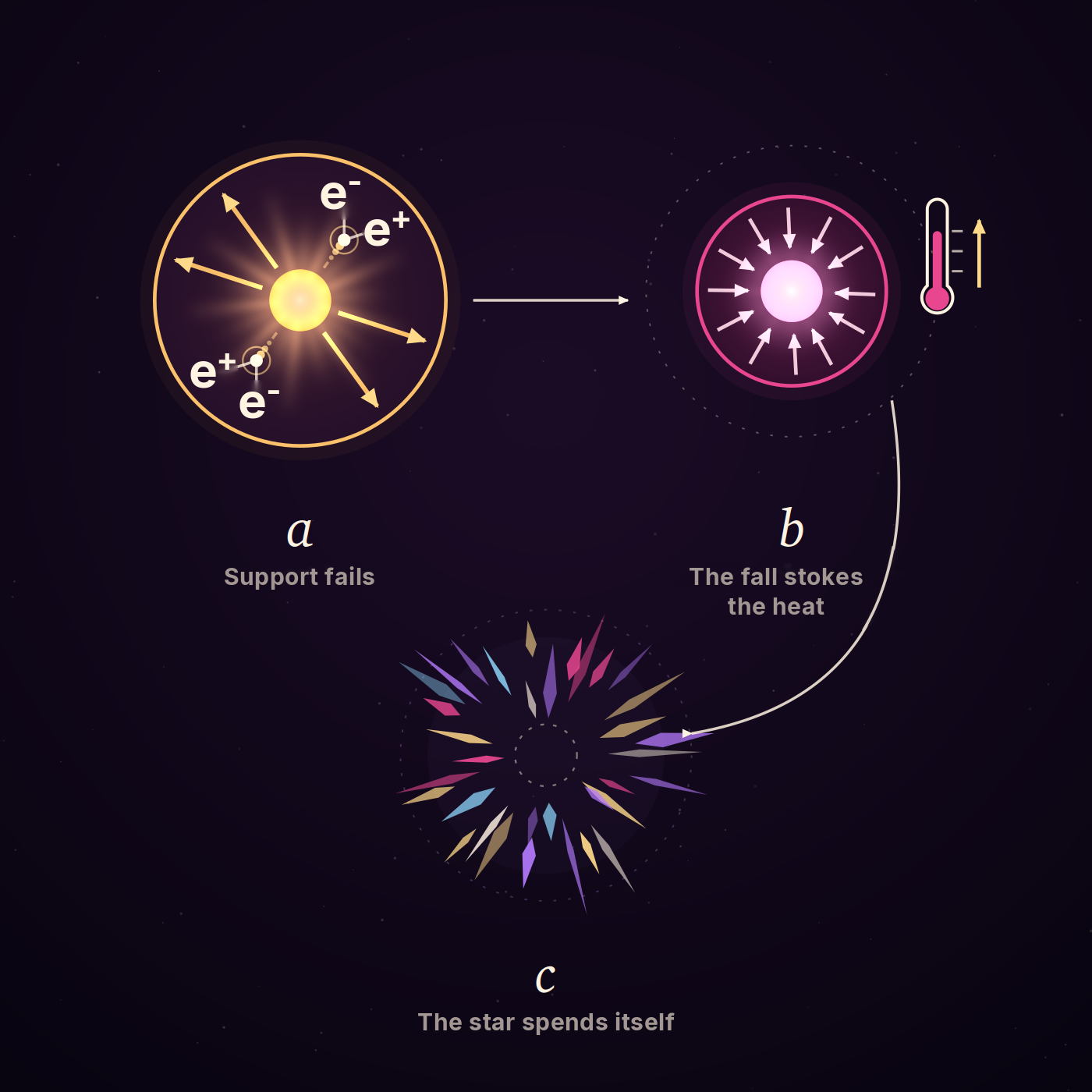
And then, in the giant stars, something really strange happens. In such stars, photon pressure is very nearly the whole of the support. That is a design flaw because if the core gets hot enough, those photons begin colliding with one another and becoming pairs of particles: an electron and its antimatter twin, a positron. And a photon that has given way to particles is a photon that has stopped pushing. Support drains away, gravity gains the upper hand, and the core contracts and heats until oxygen ignites explosively. This runaway is called pair instability, and the star is, more or less, undone by its own light. Depending on its mass, it either sheds material in a series of violent pulses and collapses into a smaller black hole, or blows apart so completely that it leaves nothing behind at all.
Pile on even more – stars that would otherwise build black holes heavier than about 130 Suns – and the collapse is so deep that it can never rebound into an explosion. These stars skip the fireworks and fall straight to a black hole again.
Between those two fates lies a forbidden band: beginning somewhere around 50 solar masses (one solar mass being the mass of our Sun) – theory cannot say precisely where – and extending to roughly 130, where dying stars, left to their own devices, are not expected to leave black holes behind.
Which is precisely where the trouble starts.
Where the edges of that band fall depends on a maddening piece of subatomic bookkeeping – how fast helium fuses with carbon to make oxygen. A faster rate turns more of the core’s carbon into oxygen, and oxygen-rich cores tip into pair instability at lower masses; a slower rate leaves more carbon behind and pushes the danger up the scale. It is one of the most stubbornly uncertain numbers in nuclear physics, and decades of laboratory effort have failed to pin it down. Change it, and the boundaries of the forbidden zone shift. File that away too.
Listening for the invisible
Here is the awkward part: black holes are, by definition, unseeable. No light escapes them. Astronomers can sometimes catch the hot gas or the stars wheeling around one, but the thing itself stays dark.
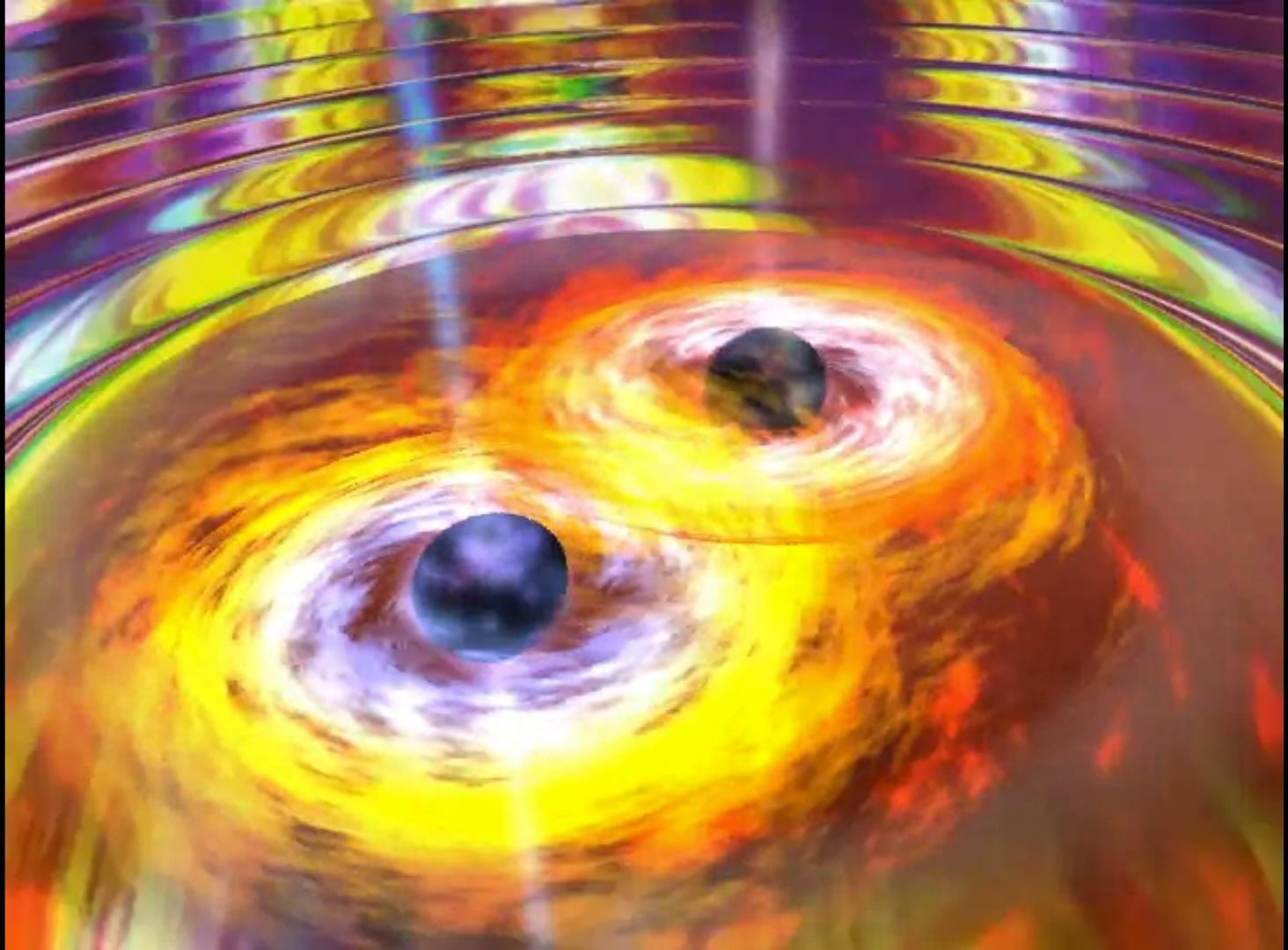
Gravitational waves changed that. When two black holes orbit each other, they shake spacetime, sending ripples across the universe; as they spiral in and finally collide, those ripples grow strong enough for detectors like LIGO to feel. From the shape of the signal, physicists can infer the black holes’ masses and spins.
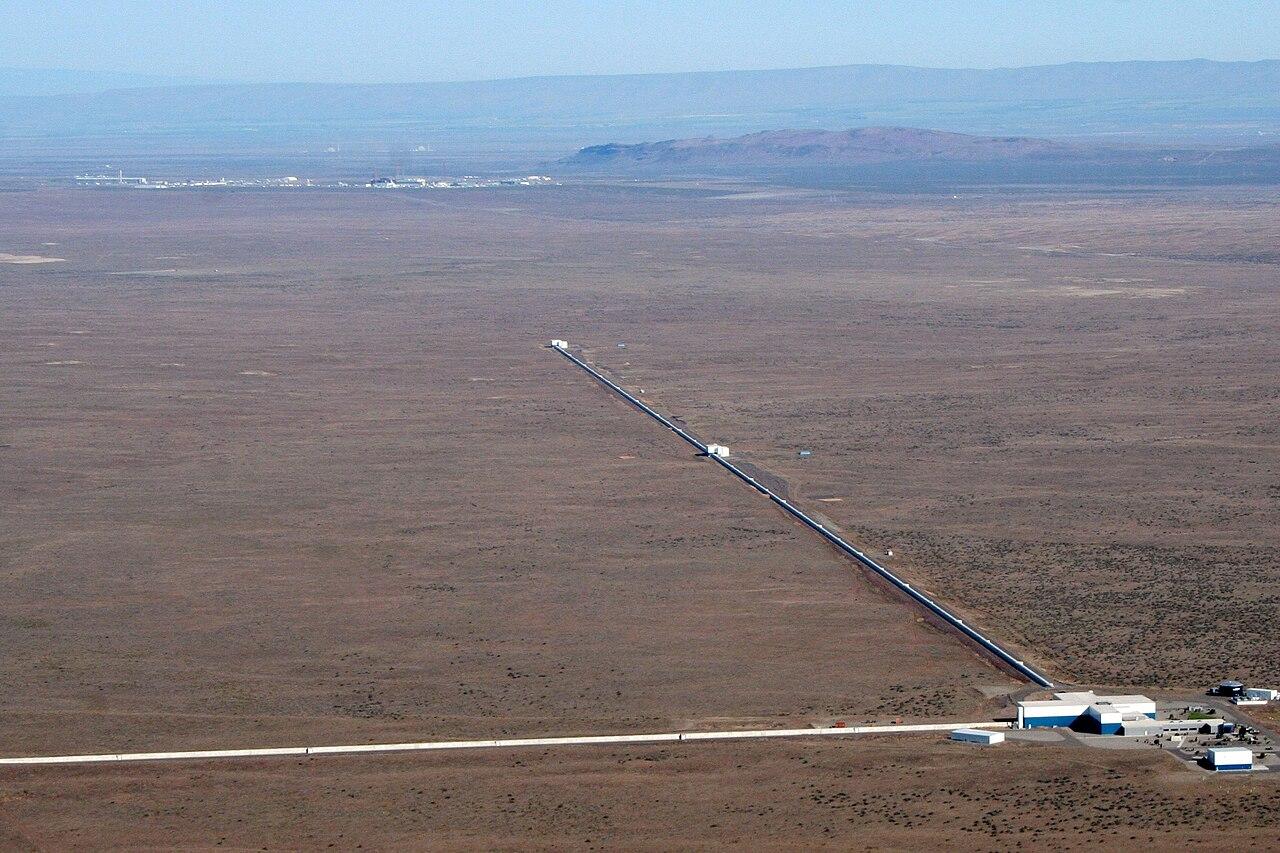
Black holes themselves had been inferred for years before that, from X-ray binaries – pairs in which a black hole and an ordinary star orbit each other, the black hole stripping gas off its companion; the gas heats up and glows in X-rays as it spirals in. So when the first gravitational-wave detection was announced, in 2016, it was historic – though for Antonini the thrill was oddly specific.
“We were already pretty sure that black holes existed in the universe. We knew them from electromagnetic observations, such as X-ray binaries. So observing black holes wasn’t really the surprising aspect of it,” he says. “The surprise was the properties of the sources. The masses of the two black holes were particularly high compared to what we had seen before with electromagnetic observations. These properties pointed towards a mechanism different from what we were expecting at the beginning.”
And that mechanism looked a great deal like the crowded stellar systems he already studied – places where black holes could meet, pair up, and merge into something bigger. “Maybe the things I was working on actually explain the detection quite naturally,” he remembers thinking.
Then the detections kept coming. “It wasn’t just one detection,” he says. “We opened, really, a new way to observe the Universe.” As the catalog swelled from a single event to hundreds, decades-old arguments became things you could test against data instead of only theory.
The pair-instability gap was one of them – and it badly needed testing, because theory couldn’t agree with itself. “The theory of massive stars is very uncertain,” Antonini says. “There is work that claims this pair-instability mass gap should exist. There is also work that says maybe it shouldn’t exist, because under certain conditions black holes might form at any mass, and so there would be no gap. So really, it’s a problem of the theory. It could be there, or it could not exist at all.”
That was the appeal. “I realized this is something we can actually test,” he says. “So let’s go and look at it in the data.”
The logic was clean. If the gap is real, direct stellar collapse should stop making black holes above a certain mass. So if LIGO kept seeing black holes up there, something else had to be making them – and dense star clusters, where black holes can merge, grow, and merge again, were the obvious suspect. Crucially, a black hole assembled that way should not look like one born directly from stellar collapse. That is what Antonini’s team set out to test.
The cliff
The paper – “Gravitational-wave constraints on the pair-instability mass gap and nuclear burning in massive stars,” in Nature Astronomy – treats the LIGO–Virgo–KAGRA catalogue (the running tally of gravitational-wave detections from the three big observatories, in the US, Italy and Japan) not as a string of individual events but as a single population.
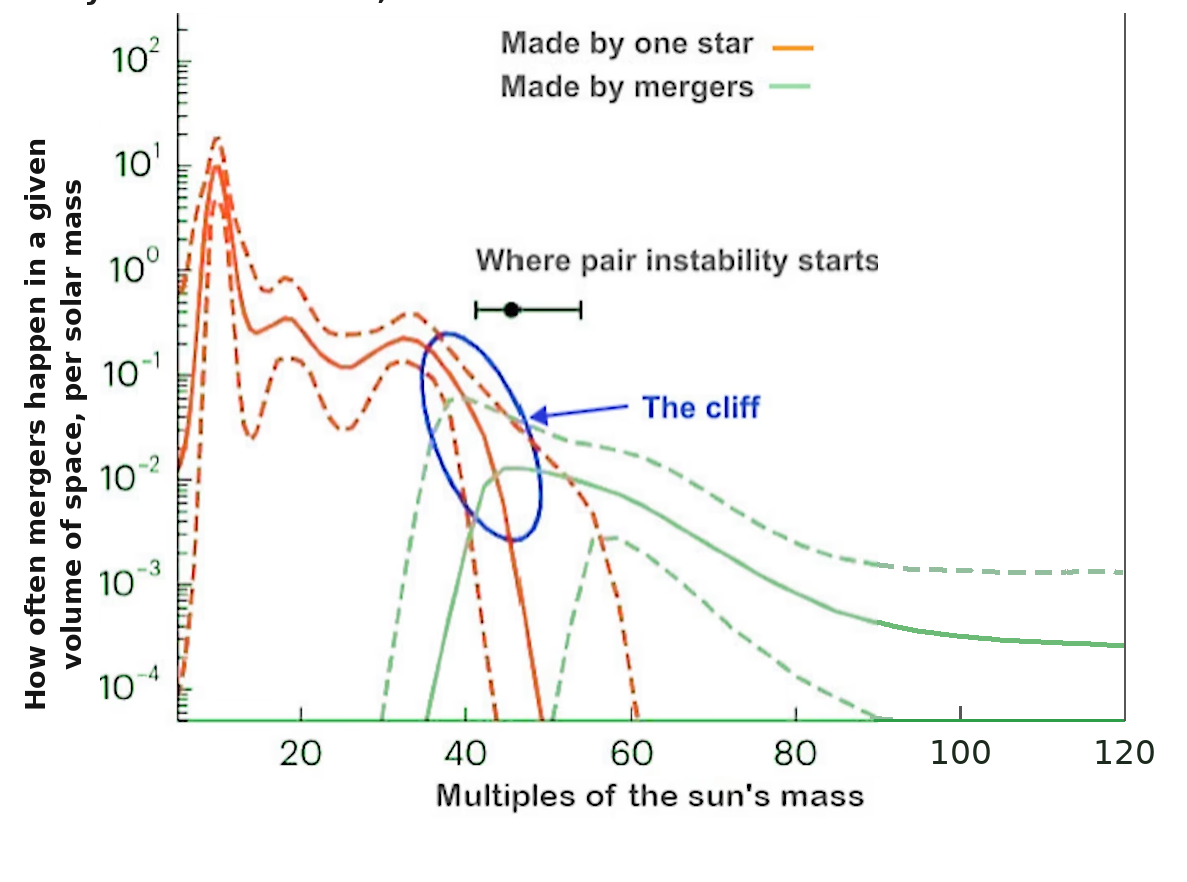
One thing the team tracked was how common mergers are at each black-hole mass. Around 40 solar masses, the picture changes sharply: the merger rate falls off a cliff – a drop of nearly a hundredfold – as though black holes made from ordinary stellar collapse abruptly become far harder to find. The team named the feature exactly that – “the cliff.”
The cliff was one clue. The analysis turned up a second, independent one: at about 45 solar masses, the black holes’ spins change character – a transition we will come to shortly. Two separate measurements, run on the same catalogue, landing within a few solar masses of each other: that near-coincidence is a large part of what makes the result convincing.
The transition appeared almost as soon as the model began to work.
“The 45 solar mass transition came up right away, very strongly from the analysis,” Antonini says.
It was exciting, but also suspiciously neat. Antonini’s background is more theoretical than data-driven, so his first instinct was not to celebrate. It was to check.
“We should make sure that what I’m doing is correct,” he recalls telling himself.
So he and his collaborators went back through the code, looking for anything that could have pushed the result into shape: a hidden bias, a model behaving too well.
But the transition stayed.
“It turned out that it was correct,” he says. “The first result that we got actually was right.”
Hesitation or excitement, at the time? “A bit of both,” he says. He had thought the result could be right. What unsettled him was how cleanly it had arrived.
Mid-answer, he breaks off. “I’m holding my baby, so she’s making some noise,” he says. “She likes to sing.” Then he picks the thread up again: “I think that it was like a bit of hesitation in the sense that we wanted to make sure that everything was right.”
And that is just what pair instability predicts: above a certain point, stars should tear themselves apart rather than leave black holes. Now for the second clue.
What the spins remember
Black holes also spin. And spin, for Antonini, was where the cluster idea looked vulnerable.
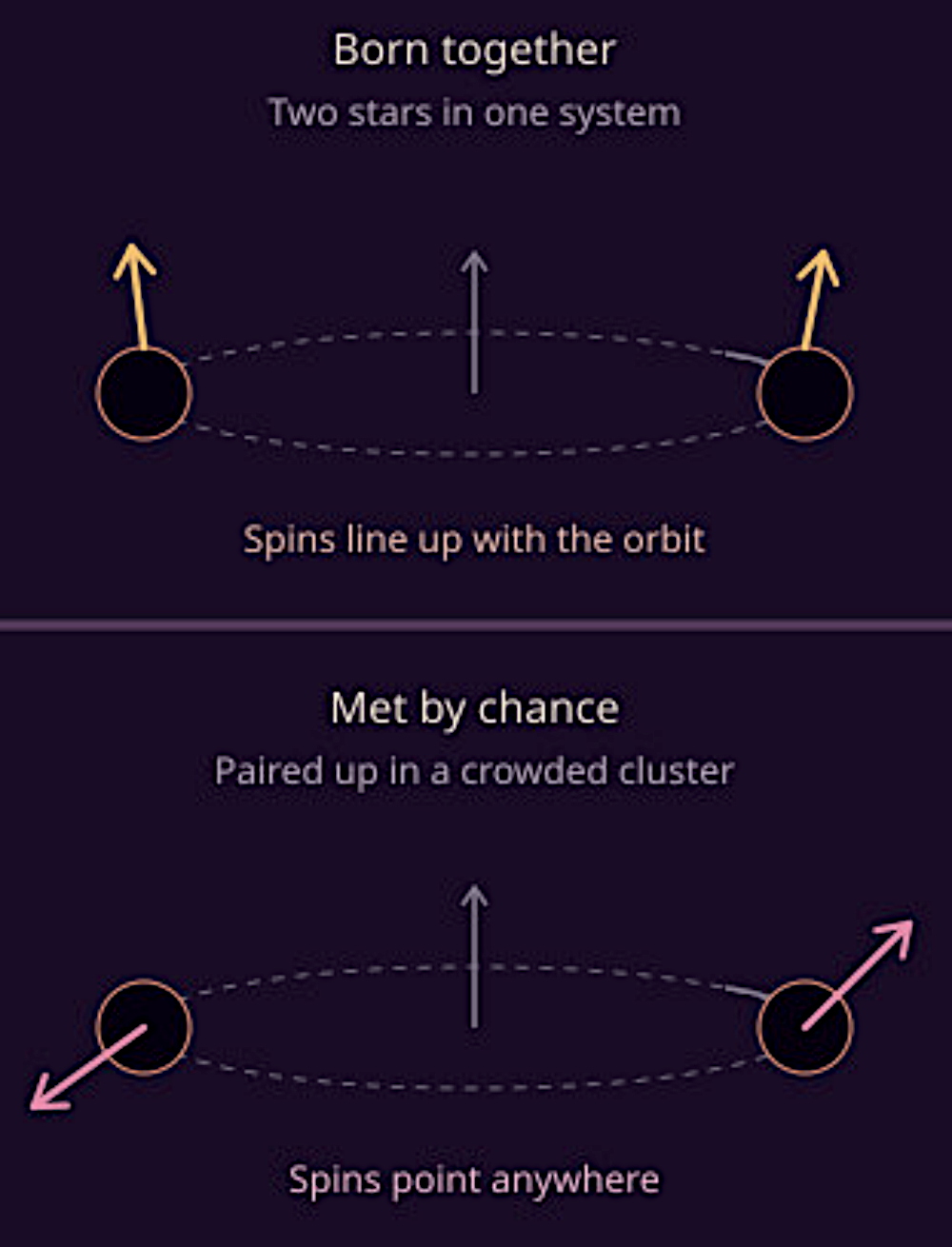
In a binary, how spins line up with the orbit betrays how the pair came together. Two stars born and raised together tend to leave black holes whose spins keep some shared order. Black holes that merely bumped into each other in a crowded cluster spin every which way.
But when researchers looked at the first individual detections, that was not quite what they seemed to show. “By looking at just the detections,” Antonini says, “one could naively think there is a bias towards spins that are aligned with the angular momentum.”
That would have been awkward for the cluster explanation. Aligned spins looked more like black holes formed through ordinary stellar evolution than through chaotic cluster encounters.
But that was the trap. Individual detections do not tell the whole story. Some spin orientations are easier for detectors to measure than others, so the team had to correct for those observational biases across the whole population.
When they did, the high-mass mergers no longer looked neatly aligned. They looked consistent with isotropy: spins pointing in random directions, just as the cluster picture predicts.
“These high spins are a memory of their previous merger,” Antonini says.
Below about 45 solar masses, the black holes look first-generation – born directly from stellar collapse. Above it, a different population dominates: larger spins, pointing every which way – the mark of black holes that have already been through a merger.
That spin pattern matters because it was exactly where the cluster idea could have failed. If the heavier black holes had not shown high, randomly oriented spins, the explanation would have been in trouble.
Antonini does not claim that clusters are the only possible story, and he draws that line himself. “We didn’t say that the cluster model is the only interpretation of the data,” he says – only that the data are consistent with it. Other models could produce similar signals. Perhaps some unknown detail of stellar evolution makes heavier black holes spin faster; perhaps isolated binaries can mimic part of the pattern. What those models cannot do is say in advance what should happen at high masses. They carry too much uncertainty to be pinned down, so almost any signature can be fitted to them after the fact.
The cluster picture has one advantage: it makes a prediction, and it makes it without any modeling at all.
“I don’t really need to run any model in order to make this prediction that above a certain mass, if there is a pair-instability supernova mass gap, then black holes should have high spin and the spin should be isotropically distributed,” he says. “That’s something that is predicted by first principles without running any simulation.”
The data matched that prediction.
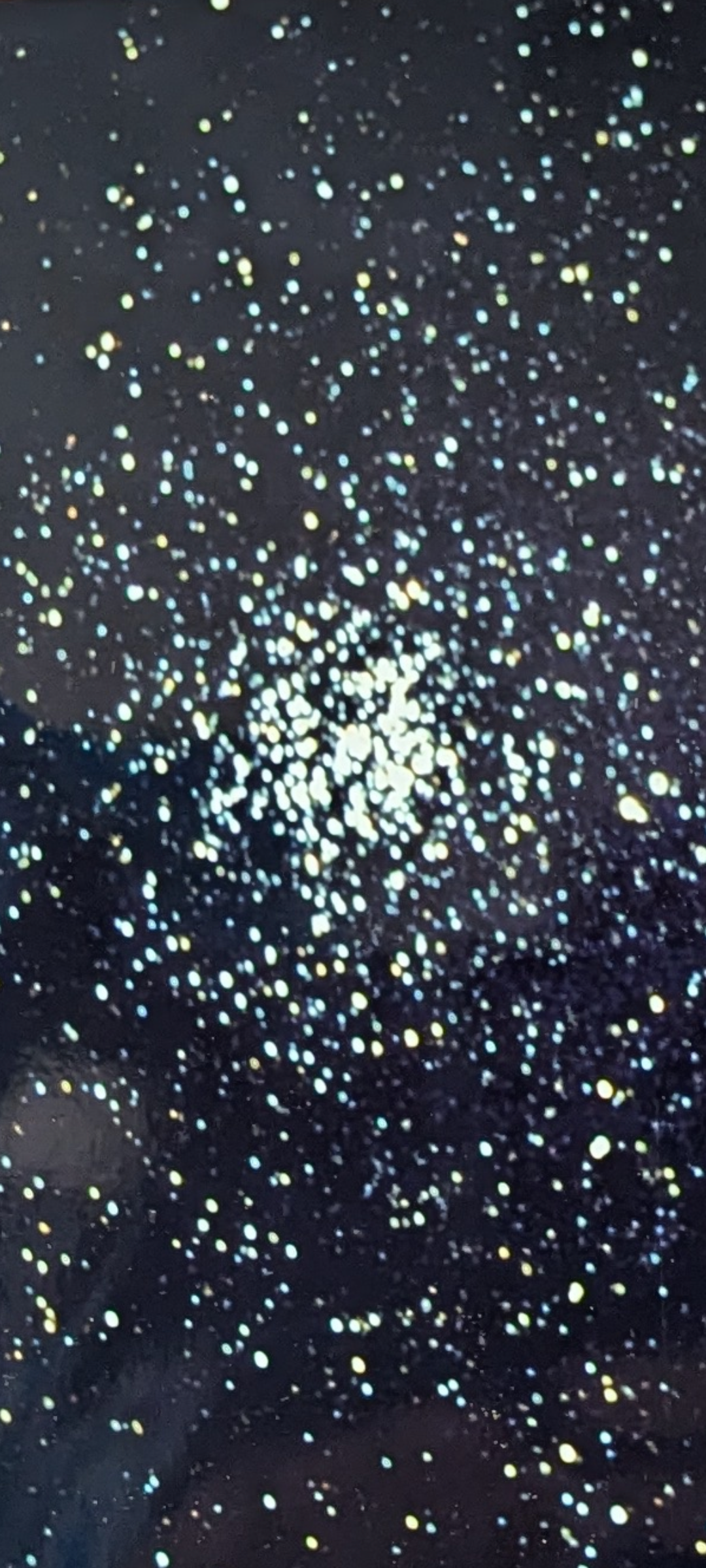
The idea behind this – hierarchical merging – isn’t new. Two black holes merge into a bigger one; if that one lingers inside a dense cluster, it can find another partner and merge again, building a kind of black-hole family tree: first generation, second, and on. Astrophysicists had discussed it for years. “Theoretically we know that in dense star clusters this should form,” Antonini says. “But we were not sure at what level they would be important.”
Trying to break it
But Antonini is careful not to oversell his argument – least of all the graph. Did the cliff leap out at him? He pauses.
“I don’t think it is completely clear yet what we are seeing, specifically when it comes to the cliff,” he says. “What is certain from the analysis is that something happens around that mass.”
At about 45 solar masses, the black holes’ spins change. And they change in just the way you would expect if the forbidden zone is real — that band of masses, from somewhere around 50 Suns up to about 130, where dying stars are not supposed to leave black holes behind — and if the black holes found sitting in it were put there by mergers in crowded clusters.
That was not the answer the team went looking for. “The whole study actually started from us trying to disprove the cluster origin,” Antonini says. Why go after your own idea? Because in this kind of science, proving a model right is a trap: “You cannot really prove that the model is right, because you can always change your model to fit the data.” A flexible model is like an excuse that keeps shifting — whatever the facts turn out to be, it can be adjusted to fit them. The only honest test is to try to break it.
“The result of the paper is that we were not able to do that,” he says. “The data are perfectly consistent with this hypothesis.”
No one else has broken it either — not the core finding, anyway. Other groups ran their own versions of the analysis and saw the same change in spins. “All the people that have done similar analysis after our publication essentially found the same result, that there is a transition.”
What they argue about is what it means. Anarya Ray and Vicky Kalogera, writing in the Astrophysical Journal Letters, say the drop in the merger rate is gentler than a cliff — more a steep hill. The details are still being argued.
The doubting is an old habit of Antonini’s. Running star-cluster simulations with Jordan Barber, then his PhD student at Cardiff, he found that the pencil-and-paper theory “doesn’t really work properly in many aspects of the simulations.” When theory and the detailed models disagree, he trusts the check over the expectation.
That failure to break the cluster idea opens onto the paper’s boldest move — and here the second thing we filed away comes due. Remember the reaction rate nuclear physicists have chased in the lab for decades: how fast helium and carbon fuse to make oxygen. That rate helps decide where the forbidden zone starts — how heavy a star has to be before pair instability tears it apart. So the team ran the logic backwards. The gravitational-wave data show where the zone begins, at about 45 Suns; and where it begins tells you how fast that reaction must run. It is like a baker who cannot see inside her oven, but can measure the cakes coming out and work backwards to how hot it must be in there.
The answer came with a number attached: about 268 keV·barns. A barn is the unit nuclear physicists use for how big a target a nucleus makes — a joke that stuck from the Manhattan Project, where certain nuclei were so easy to hit that physicists said you might as well be aiming at the side of a barn. The measurement still carries wide margins of error, but it agrees with the best laboratory work and, the team argues, pins the number down more tightly than the laboratories have managed. A stubborn lab problem, probed through dead stars.
“It opens a door,” Antonini says, “to do even new astrophysics or physics with gravitational-wave data.”
Cosmic archaeology
Asked whether the work feels like cosmic archaeology, Antonini seems to like the comparison. “You are observing the bones, or the ruins,” he says. “The aftermath of the evolution of the stars and the dynamics of the black holes.”
It may sound overwhelming: reconstructing the lives of stars and black holes from tiny signals detected here on Earth. But Antonini does not quite see it that way.
“It’s kind of fun,” he says. “Exciting, most of all because it’s the first time that we can do this kind of thing. The fact that we are doing that is kind of an honor.”
It began with a ten-year-old pointing a small telescope at the night sky. The telescope has given way to a gravitational-wave detector; the Moon and planets to black-hole clusters in distant galaxies; the little book of constellations to simulations, catalogs and papers full of carefully documented uncertainty.
The feeling, though, hasn’t much changed.
“The most astonishing aspect,” he says, “is that we can actually describe, or hope to understand, the universe.”
Read this story in a shorter version, written for younger readers

Mina Rehman is a science writer trained in physics, astrophysics and science communication. She writes about everything from black holes and ancient galaxies to crime-solving AI, vanishing vultures and birds that nap mid-flight, uncovering the wonderfully strange stories hidden across science.
The link to the original article
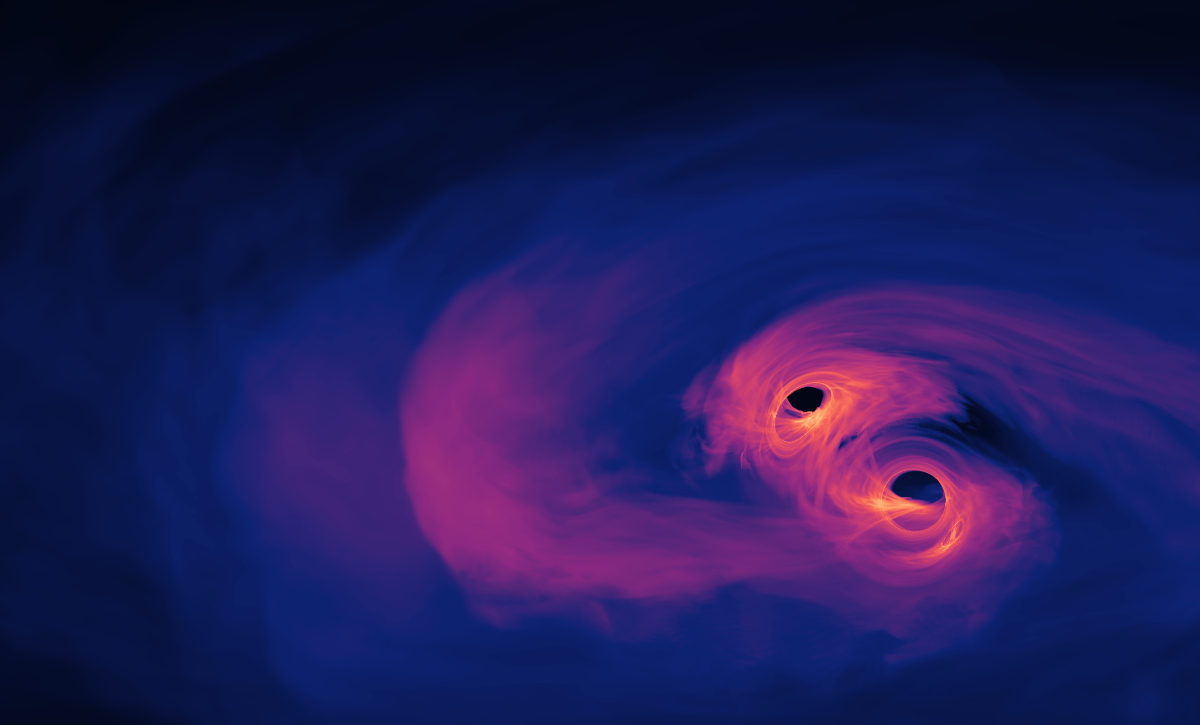
Lead image: Merging supermassive black holes. Image: NASA’s Goddard Space Flight Center/Scott Noble; simulation data, d’Ascoli et al. 2018