
New evidence says you don’t wait to exhale as you chill and flush the brain
Kara Hoving
Read this story in a shorter version, written for younger readers
If you speak with Adam Martinac about his research, don’t be surprised if you find yourself stifling a yawn.
The biomechanical engineering postdoc’s findings can even leave his colleagues drowsing.
“I still present my work at the end of lab meetings because this research would trigger this wave of yawns throughout the group until eventually everyone’s distracted,” says Martinac with a chuckle.
The research is far from boring, though. Martinac and his team at the University of New South Wales Sydney and Neuroscience Research Australia (NeuRA) are working to reveal the physiological purpose behind the contagious yet enigmatic act of yawning.
An enigma wrapped in a mystery
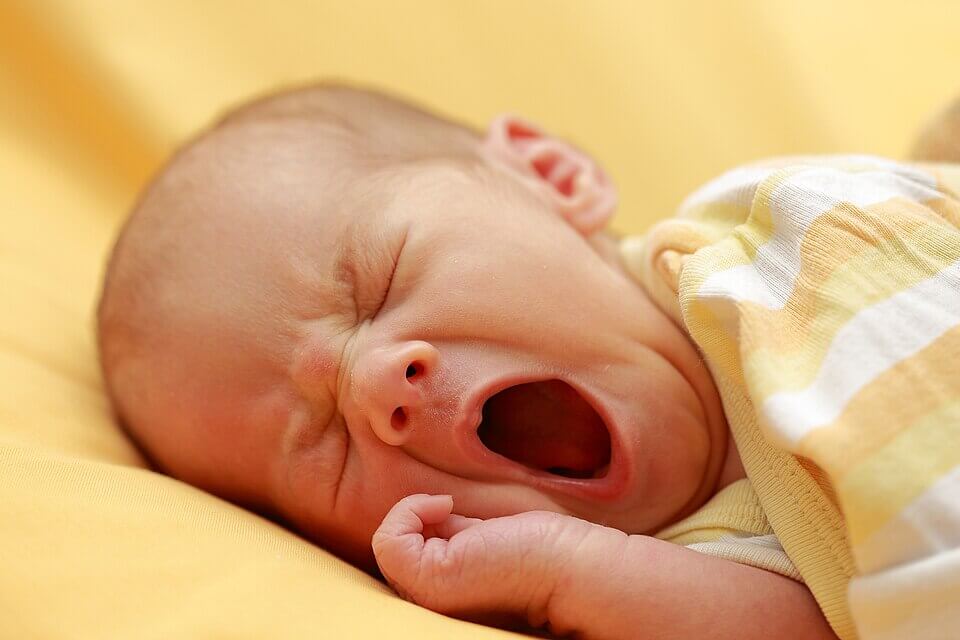
Most vertebrates yawn – even fish. Whether you’re a human or a hamster, yawning typically follows the same pattern: a long intake of breath with the mouth open wide, followed by a period of stretching and tension in the mouth and throat, and a quick release of both the breath and muscle tension.

Usually seen in the period between sleep and wakefulness, yawning is also triggered in some cases by generic stress, including hunger. Seeing or hearing yawns in others can also trigger yawning in highly social species like dogs and chimpanzees. Simply reading or talking about them can elicit yawns in humans – a fact that Martinac is never allowed to forget.
It begins with a hypothesized pattern of activity generated in the brain stem, similar to those involved in swallowing, breathing and moving. This activity finally results in a yawn. There was also some evidence suggesting that deep breathing may have similar effects as yawning on blood and other fluids.
Despite their ubiquity, the reasons behind why we yawn have yet to be resolved by scientists. New research by Martinac’s team may help to unravel this mystery.

Martinac and his colleagues used magnetic resonance imaging (MRI) to observe how yawning affects the movement of blood and fluids in the skull and neck. The results, published in April in Respiratory Physiology & Neurobiology, showed that yawning triggered a unique pattern of fluid flowing away from the brain. This maneuver, distinct from flow patterns during normal deep breathing, suggests that yawning may play a role in cooling and clearing waste products from the body’s vital control center.
It’s all in your head
Originally, yawning was not on Martinac’s mind. “My background is originally in mechanical engineering and computational simulations, where I became interested in adapting the techniques learned there for medical research,” he says. “Then I became fascinated by sleep, neurodegeneration, and how the human brain clears metabolic waste.”
“During my PhD, my supervisor suggested it would be highly beneficial to learn MRI since engaging directly with human recruitment and experimental analysis allowed me to better understand the underlying physiology, which in turn helps me build more accurate computer models.” His recent research has focused on investigating the flow of cerebrospinal fluid in the brain.
Cerebrospinal fluid (CSF) is a clear fluid that surrounds and protects the brain and spinal cord, acting as a shock absorber. Floating in it, the brain, which naturally weights about 1.3 kg (about 3 lbs), appears to weigh only about 50 grams (less than 2 oz).
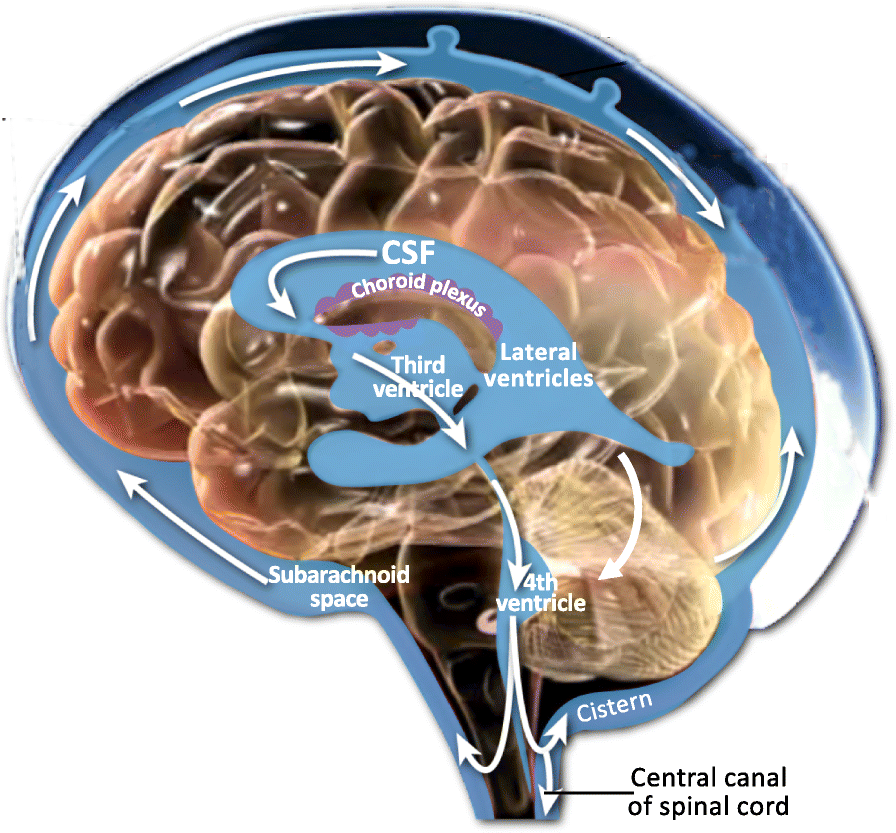

We have four connected hollow regions in our heads called ventricles. On the walls of each is a choroid plexus, a network of specialized cells and blood vessels that produce most of the CSF in the head and spinal cord.

CSF also regulates pressure and ambient temperature within the skull and affects the flow of nutrients and solutes to and from the brain. It is well known that jaw and mouth movements that compress the jugular vein can increase CSF pressure in the brain. Breathing-induced changes in the chest and lower back are also linked to variations in CSF pressure.

CSF is also important in clearing waste products from the brain, a phenomenon Martinac has researched previously in the context of sleep.
“I was looking at sleep and waste clearance mechanisms in general, and just how the brain might be able to clear waste, which is kind of a mystery,” says Martinac. “We know it must get rid of stuff, because the brain is using a lot of energy and churning out a lot of waste.”
The human brain accounts for about 20% of the body’s metabolic energy use. Understanding how it clears waste is important for decoding neurodegenerative diseases like Alzheimer’s and Parkinson’s, which are linked to a build-up of toxins and other waste products in the brain.
A world of inquiry
Martinac grew up in a family that encouraged him to explore and investigate the world.
“My parents had a huge influence on the way I think and approach research,” he says. “My mother was in Spanish linguistics and my father was in biophysics, so science, literature, ideas, and discussion were always around me growing up. I spent a lot of time visiting them on various campuses as a kid, wandering through labs, doing little ‘experiments,’ seeing research as something alive and creative rather than a distant abstraction.”
His father, Boris Martinac, is one of the world’s foremost experts on mechanoreceptors in the body. In 2021 the Nobel Committee’s scientific background to that year’s Physiology prize credited Boris Martinac and Ching Kung with establishing that mechanosensitive channels exist. The prize itself went to David Julius and Ardem Patapoutian. Despite the academic environment he grew up in, Martinac says a career in the lab was a matter of choice.

“There was never any pressure to follow that path. I actually stumbled around quite a bit during my undergraduate studies before finding my way into research through my engineering honors project, which I did in my father’s laboratory. That project introduced me to computational modeling of mechanosensitive ion channels, which eventually led me into modeling fluid flow in the central nervous system, and then into MRI studies of respiratory maneuvers like yawning and breathing. So [my parents’] influence was less about pushing me into academia and more about making investigating ideas and concepts feel like a very natural thing to do.”
At the University of New South Wales Sydney, Martinac again has a stimulating environment to work in.
His boss Lynne Bilston has a storied career, having helped reduce the number of children injured or killed in car crashes in Australia and worldwide with studies that explored how the body responds to crashes and objects flying in cars. Among other things, she also studies sleep apnea, tongue muscles, and flow patterns of cerebrospinal fluid.
Working with her, he had previously used MRI techniques to investigate CSF flow during other respiratory maneuvers, such as coughing and sniffing. Before he left, a master’s student had the idea to look at yawning, and Martinac eventually took charge of the project.
“The genesis [of the idea] was one of luck and chance and curiosity,” he says.
The study used phase contrast MRI to observe participants while yawning and breathing deeply.
Portrait of a yawn
The research team used phase contrast magnetic resonance imaging (MRI), which generates moving pictures instead of static images like a standard MRI. This let them observe real-time tissue, CSF, and blood movement in the head and neck in 22 study participants.
Given that a fake yawn lacks the same physiological triggers and responses seen in a real one, the researchers needed a way to cause real yawns in participants. Instead of boring their poor subjects to the point of setting off an investigation by the university’s Institutional Review Board, (or Human Research Ethics Committees in Australia), they relied on an old trick. They showed them videos of yawning animals and people. Sure enough, it was contagious.
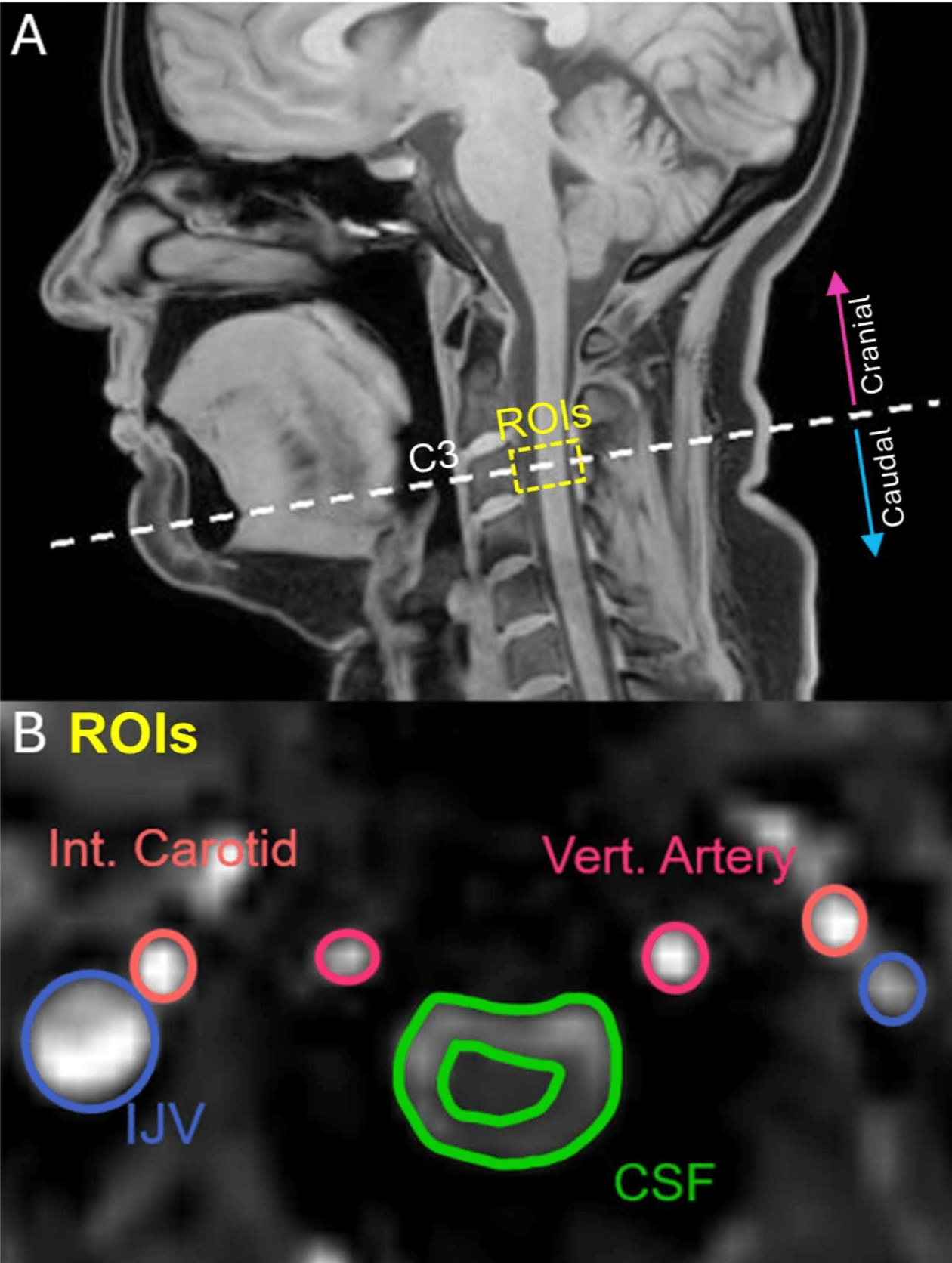
B. Cropped view showing where the cerebrospinal fluid (between green lines) is located. Also seen are the internal jugular vein (blue), internal carotid (orange), and vertebral arteries (pink). Image courtesy Respiratory Physiology & Neurobiology. CC 4.0 BY
“Our biggest experimental challenge was consistently eliciting yawns,” says Martinac. “Participants reacted (or didn’t react) to the contagious yawning stimulus, especially when they were under pressure to perform inside the scanner. This made data collection quite tricky, since we were trying to get full yawns, as well as several yawns per person for each sub experiment.”
The participants were also trained to stifle yawns and to take a gaping deep breath to fake a yawn. They were then scanned while breathing normally, yawning without restraint, stifling their yawns, and taking a gaping deep breath.
Researchers also measured airflow using a spirometer, but without the standard mouthpiece. It’s hard to yawn when you have a pipe stuck in your mouth.
They also measured tongue movements, given that the bit behind the tip of the tongue blade is sharply but consistently displaced in a real yawn. It helped that, in an MRI, the details of the tongue blade were easy to see, thanks to some sharp visual contrast in the tissues and the stable pockets of fat beneath.
As expected, the unrestrained and stifled yawns lingered around 11 seconds, while the faked ones lasted about half the time. No surprise there.
During normal and deep inward breathing, researchers observed that venous blood (i.e., blood which has already delivered oxygen and nutrients) flows out from the skull and back towards the heart, while cerebrospinal fluid flows into the skull.
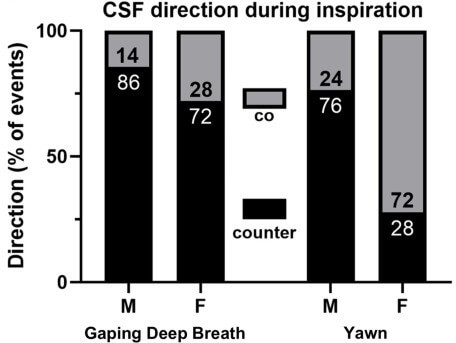
But during a yawn, something odd happened: both CSF and venous blood flowed outward from the brain in the same direction.
This outcome surprised Martinac and colleagues, who had hypothesized that yawning would have the same effect as taking a deep inhalation. The researchers speculate that this outflow of CSF during yawning may be important for flushing away waste. It could also help clear out accumulated chemicals linked to sleep-wake regulation.
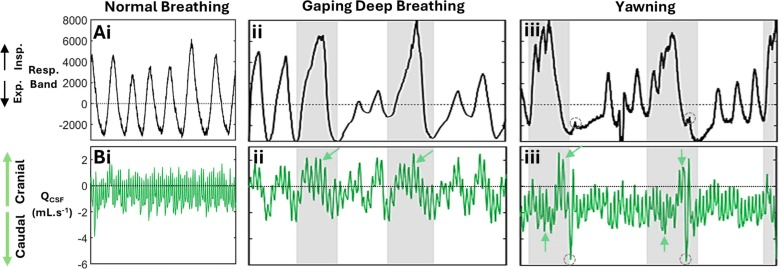
Bi through Biii shows direction of CSF flow towards the brain (cranial) and towards the spine (caudal).
When yawning, more CSF flows out. Image courtesy Respiratory Physiology & Neurobiology. CC 4.0 BY
Bumps in the road
No scientific study is without its limitations. In this instance, the scientists observed that the co-directional flow pattern was consistent in female subjects, but not in males.
The researchers figured out that this result was due to a limitation in the imaging method: when subjected to that MRI sequence, men were more likely to be affected by odd sensations in the peripheral nervous system. This a side effect of MRI characterized by a tingling or shaking feeling caused by stimulation of the nervous system. It is rarely seen in women.
The scientists concluded that this sensation disrupted the male subjects’ normal breathing. But without the influence of the MRI, that is under ordinary conditions, CSF flow in males would follow the same patterns seen in a majority of the female subjects.
The brain’s cooling system
The results also indicated that yawning may play a role in regulating the brain’s internal temperature.
According to Martinac, there is a very narrow band of temperatures in which the brain can optimally function, in a steady and balanced state known as homeostasis. While the precise range is not yet clear, heating the brain above an optimal temperature range creates a risk of cell damage, seizures, and cerebral swelling. Excessive heat is also associated with changes in cognition, emotion, and behavior.
Previous research has shown that yawning increases in many species, including humans, when brain temperature rises above a certain threshold (though it eventually drops off at an even higher temperature). The UNSW study, which did not measure temperature variations, may still help explain why this occurs.
“In humans, the brain tissue can be up to 1 degree Celsius warmer than the rest of the body, and venous blood leaving the brain is typically about 0.2-0.3 degrees warmer than the arterial blood entering it,” Martinac said in a press release.
During a yawn, warm venous blood flows out of the brain, allowing cooler arterial blood to flow in. The additional outflow of CSF from the brain during yawning, says Martinac, creates a “maximal shift” in fluid exchange in which the largest possible amount of fluid leaves the brain, transferring heat with it. This supports the hypothesis that yawning helps the brain cool itself down.

Unique ‘fingerprints’
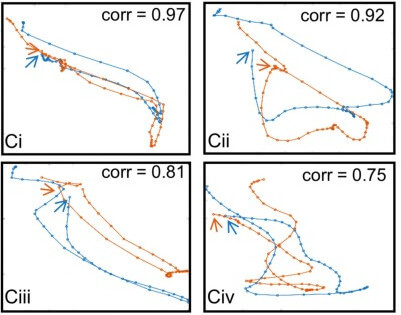
The researchers also discovered something unexpected: each individual appears to have a “signature” tongue movement every time they yawn. These movements are highly complex — with lots of “wiggling and wobbling,” according to Martinac — and unique to each individual, even when they were attempting to suppress a yawn.
Why is this important? This finding supports the view that yawning is governed by a central pattern generator, or CPG. CPGs are neuron clusters that autonomously produce rhythmic motor behaviors like walking, chewing, or breathing without expending a lot of brain power or conscious thought. The fact that individuals yawn the same way every time is consistent with the idea that yawning may be coordinated by such an autonomous network.
Central pattern generators originate in the brainstem and spinal cord, which makes them evolutionary very old. According to Martinac, yawning is one of those behaviors that is evolutionarily conserved across tens of millions of years.
“We have crocodiles and Komodo dragons and possibly even dinosaurs yawning,” says Martinac. “That likely means it’s fundamental in some way, because otherwise it wouldn’t have stuck around that long.”
A possibly vital behavior
If yawning is controlled by the same type of core pathway that controls vital functions like walking or breathing, could that mean that yawning is more important than previously thought?
Martinac thinks it’s possible. He posits that yawning may have evolved as a peripheral mechanism to help the brain maintain itself by assisting with thermoregulation and waste clearance. He characterized yawning as an additional, possibly even redundant, adaptation that adds an extra layer of protection for maintaining homeostasis.
The study’s findings have opened a host of new questions. Martinac hopes additional MRI studies, particularly on the details of heat exchange during yawning, will clarify its role in thermoregulation. With more research, he hopes he can reduce the yawning gap between the known and the yet unknown.
With inputs from P Rajendran
Read this story in a shorter version, written for younger readers
 Kara Hoving is a freelance writer and editor specializing in sustainability and science communication. She holds a master’s degree from Yale University and lives in Hawai’i.
Click here for the original article